
🇬🇧 EN/HU
Request a consultation

METHODOLOGY & RULES OF ENGAGEMENT

The testing approach is shaped by the objective, scope and level of access.

The assessment model depends on the business objective, systems in scope, available information and agreed testing constraints. The methodology and Rules of Engagement are defined before testing begins.

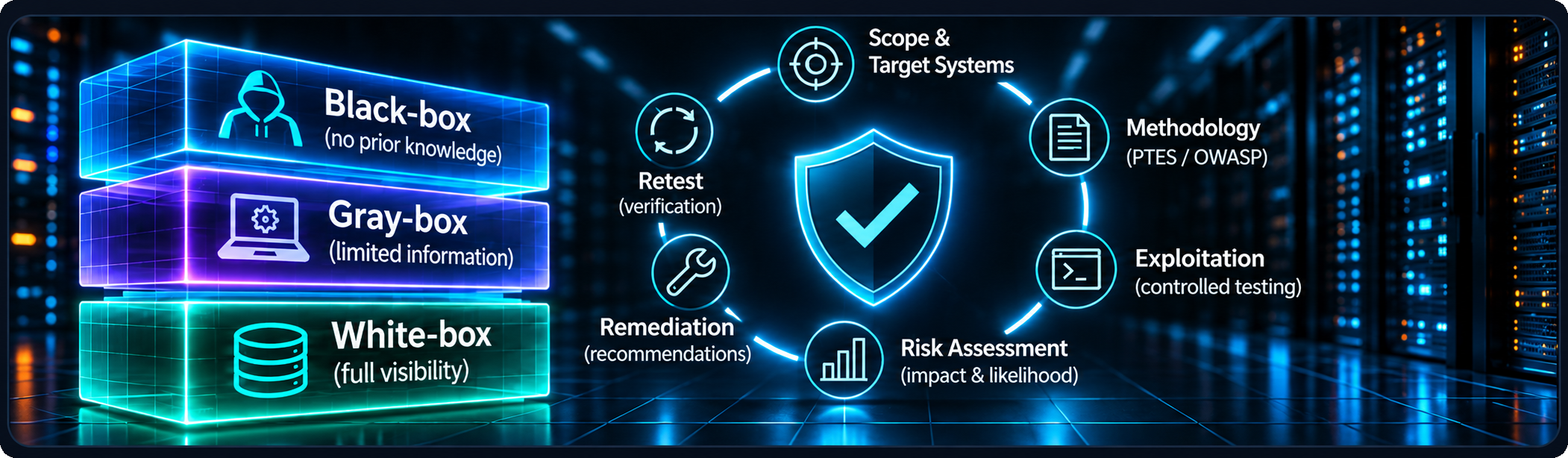
A black-box, gray-box and white-box security testing methodology visual
01 / BLACK-BOX

Black-box — no prior internal knowledge

The tester receives no internal documentation, configuration details or user access beyond the agreed target scope. Discovery relies on information available to an external party. This approach evaluates externally visible exposure, information leakage, reachable services and attack paths. Reconnaissance may take a larger share of the engagement, so coverage and time limits are agreed in advance.

02 / GRAY-BOX

Gray-box — limited information

The tester receives selected information such as test credentials, defined IP ranges, API documentation or an architecture overview. This enables focused assessment of authenticated functionality, role and permission boundaries, internal attack paths and privilege escalation opportunities. Gray-box testing often balances realistic attack conditions with efficient coverage.

03 / WHITE-BOX

White-box — detailed technical access

The assessment uses available architecture documentation, configurations, source code, test accounts and other internal context. It supports deeper and more targeted analysis of logic, configuration, access-control and implementation weaknesses that may not be visible from an external perspective. The emphasis is on coverage and precise validation.

04 / ENGAGEMENT CONTROL

Authorised testing and Rules of Engagement

Active testing is conducted only against documented scope approved by the client. The engagement defines domains, IP ranges, systems, testing windows, permitted techniques, exclusions, contacts, incident procedures and stop conditions. Authorisation must be provided by the system owner or an appropriately empowered representative; third-party systems are excluded unless separately authorised.

COMMON PRINCIPLES

Controlled testing. Evidence-based findings.

Findings are validated against technical and business impact. Exploitation depth, data handling and any changes are limited by the engagement rules. The objective is to demonstrate risk and support remediation—not to disrupt operations unnecessarily.

SELECTING THE RIGHT APPROACH

Let's define the testing model that answers your security questions.

We recommend an approach based on scope, access and desired outcomes.

Request a consultation ↗